Boston has no separate car seat ordinance. Families here follow Massachusetts state law, which applies in Boston, Cambridge, Quincy and every other town in the Commonwealth. This guide covers what the law requires, what safety experts recommend beyond the legal minimum, and where to get free help.
What Massachusetts Law Requires
Under Massachusetts car seat laws, all children in passenger motor vehicles must ride in a federally approved child passenger restraint, properly fastened and secured according to the manufacturer’s instructions, until they are 8 years old or over 57 inches tall. That height is 4 feet 9 inches.
The rule is “or,” not “and.” A child who turns 8 but is still under 57 inches is no longer covered by the legal requirement. Pediatric safety experts still advise a booster until the seat belt fits properly, which is typically between ages 8 and 12.
Children aged 8 to 12 must wear a safety belt. Anyone aged 12 and older must wear a seat belt in any motor vehicle, in the front or back seat.
The Law vs. Best Practice
Massachusetts law is a minimum standard, and it is less detailed than the guidance from pediatricians. Here is how the two compare:
- Rear-facing: The law does not set a rear-facing age. The American Academy of Pediatrics recommends keeping children rear-facing as long as the seat’s limits allow, often beyond age 2.
- Back seat: State law does not require children to ride in the back seat. The state’s own safety tips advise keeping kids in the back seat until they are 13.
- Booster use: The law ends at age 8 or 57 inches. Experts say to keep using a booster until the lap and shoulder belt fit correctly.
Lawmakers have considered bills to strengthen rear-facing rules, but I found no evidence that a bill has become law. Check the Massachusetts Legislature’s website for the current status.
Choosing the Right Seat by Stage
The state’s important tips on car seats outline these stages:
Infants and toddlers (rear-facing). Infants should always ride rear-facing, and infant-only seats can only be used rear-facing. Once a child reaches the top height or weight limit of the seat, a convertible seat can keep them rear-facing longer.
Toddlers and preschoolers (forward-facing with harness). Once a child outgrows the rear-facing seat, they move to a forward-facing seat with a harness. Always use the top tether, which reduces head movement in a crash.
School-age children (booster). Once the forward-facing seat is outgrown, a booster in the back seat is the next step. A booster positions the adult belt across the strong bones of the hips and chest rather than the soft abdomen.
Seat belt. A child is ready for the adult belt only when they can sit against the seatback with knees bent at the edge of the seat. The lap belt must sit low across the upper thighs and the shoulder belt across the chest, not the neck or face.
Penalties for Violations
A driver who violates the child restraint law faces a fine of up to $25. Because the fine is small, it can seem like a minor matter. But the fine is not the point. Crashes are among the leading causes of injury to children, and about 2,100 Massachusetts children ages 7 and younger are treated for nonfatal crash injuries each year.
Taxis and Ride-Hailing in Boston
Boston families often get around without a private car, so this question comes up a lot. The state law includes an exception for licensed taxis that aren’t equipped with child restraints. The rules for ride-hailing services like Uber and Lyft are less clear, and some commentators say you should plan as though the standard rules apply. For anything beyond a short trip, the safest approach is to bring your own seat. Lightweight travel seats and some inflatable boosters exist for this purpose. Confirm the specifics with the state before relying on any exception.
Installation Mistakes to Avoid
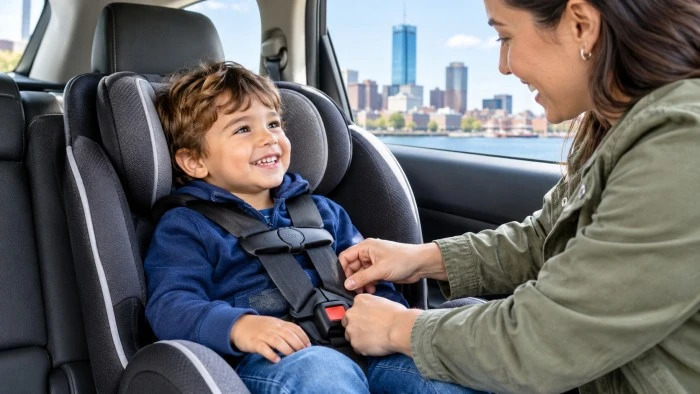
A seat that is the right type but poorly installed can still fail. Common errors include:
- Loose installation. The seat should not move more than an inch side to side or front to back at the belt path.
- Harness straps too loose. You should not be able to pinch webbing at the child’s collarbone.
- Wrong chest clip position. The clip belongs at armpit level.
- Bulky coats. Puffy winter jackets compress in a crash and leave the harness slack. Buckle the child in, then place the coat or a blanket over the harness. This matters in New England winters.
- Using an expired, recalled or crashed seat. Car seats have an expiration date, so check the manufacturer’s information. You can check for car seat recalls on NHTSA’s website. Most manufacturers say to replace a seat after a moderate or severe crash.
Always follow both the car seat manual and your vehicle owner’s manual. Each has specific instructions for the belt or LATCH system.
Get Your Seat Checked for Free
A certified Child Passenger Safety Technician can check that your car seat is installed properly and fits your child, for free. Massachusetts lists inspection sites at mass.gov/childsafetyseats. Many local police and fire departments and hospitals offer appointments, though availability varies. Some programs have paused services, so call ahead. Programs for free or discounted booster seats may also be available through the state’s child safety seat resources.
Quick Reference Checklist
- Under 8 and under 57 inches: federally approved restraint required.
- Rear-facing as long as the seat’s limits allow.
- Harness with top tether once forward-facing.
- Booster until the adult belt fits correctly.
- Back seat until age 13.
- Check for recalls and expiration dates.
- Get a free professional inspection.
Final Thoughts
Massachusetts law sets a baseline, but a child’s safety depends on choosing the right seat, installing it correctly and using it every trip. Check the current statute and the Mass.gov guidance linked below, since laws can change.